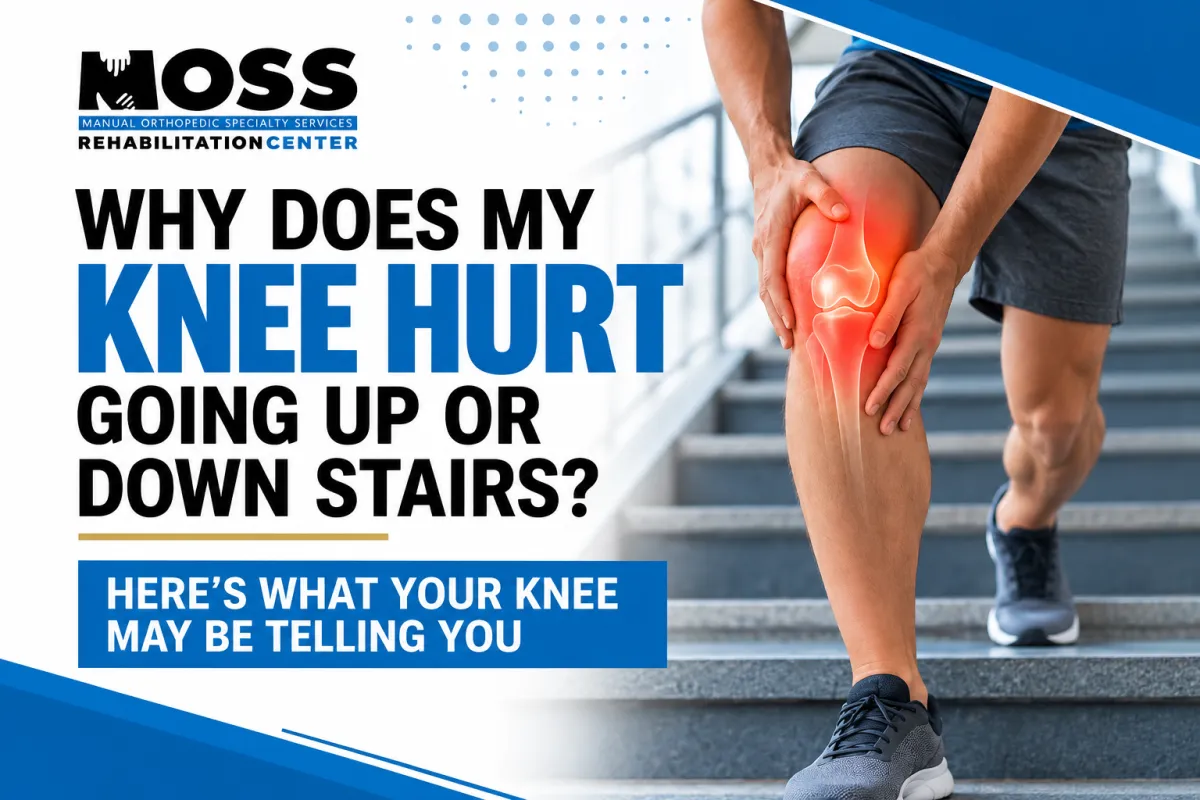
Why Does My Knee Hurt Going Up or Down Stairs? Here's What Your Knee May Be Telling You
Have you ever noticed that your knee feels fine while sitting, but the moment you walk up or down the stairs, you feel pain?
You are not alone.
Stair climbing can place a significant demand on the muscles and structures around your knee. For some people, the pain may be related to muscle weakness or poor movement control. For others, it may be associated with irritation around the kneecap, arthritis, a tendon problem, or a previous injury.
The important thing is this: knee pain on the stairs is a symptom, not a diagnosis.
Understanding when and where your knee hurts can provide useful clues about what may be contributing to the problem.
Why Do Stairs Make Knee Pain Worse?
Walking on level ground is different from climbing or descending stairs.
When you climb stairs, your leg muscles have to produce more force to lift your body upward. Your quadriceps, the muscles on the front of your thigh, play an important role in straightening and controlling your knee.
When you walk down stairs, your quadriceps have another challenging job. They must control your body as you lower yourself from one step to the next.
If the muscles around your knee and hip are not strong enough, or if your movement mechanics are not ideal, stair climbing may expose a problem that is less noticeable during regular walking.
Lack of muscle strength and flexibility can contribute to knee problems, while strengthening the muscles around the knee can improve stability and function.
Does Your Knee Hurt More Going Up or Going Down?
This small detail can actually be helpful when trying to understand your symptoms.
Knee Pain Going UP the Stairs
If going upstairs is particularly painful, your knee is being asked to produce more force as you push your body upward.
Pain around the front of the knee may sometimes be associated with patellofemoral pain, which involves the area around and behind the kneecap. This type of pain commonly becomes worse with activities such as climbing stairs, squatting, or sitting with the knee bent for long periods.
Pain below the kneecap may also occur with irritation of the patellar tendon. Patellar tendinopathy can cause pain during activities that place repeated stress on the tendon, including climbing stairs.
Knee Pain Going DOWN the Stairs
Going downstairs requires your muscles to control your body as you lower your weight.
This can be particularly challenging if your quadriceps are weak or if you have difficulty controlling the position of your knee.
Some people also experience pain related to osteoarthritis or other knee conditions that make activities such as stairs, squatting, or lowering into a chair more difficult.
So if you notice that going down the stairs hurts more than going up, don't automatically assume your knee is simply "getting old."
It may be telling you that something about your strength, mobility, or movement needs attention.
Don't Just Avoid the Stairs Forever
When something hurts, your first instinct may be to avoid it.
And if an activity is significantly increasing your pain, temporarily modifying it may be appropriate.
But avoiding stairs indefinitely doesn't necessarily address why the stairs hurt in the first place.
The goal should be to figure out what is contributing to the problem and then gradually restore your ability to perform the activity.
Depending on the cause, treatment may include:
Improving knee and hip strength
Restoring flexibility and mobility
Improving balance and stability
Retraining movement patterns
Modifying activities while symptoms settle
Gradually increasing your tolerance to stairs and other activities
For certain knee conditions, physical therapy may help reduce pain, improve strength, stability, flexibility, and movement.
Take Action Today
Knee pain does not have to become something you simply learn to live with. Whether your knee hurts going up stairs, going down stairs, squatting, walking, or getting up from a chair, understanding the cause is an important first step toward getting better.
If knee pain is making everyday activities harder, call MOSS Rehabilitation Center at 817-220-6677 to schedule your FREE Discovery Visit and learn how physical therapy may help you move better, build strength, and get back to doing the things you love.
We can help you understand what may be contributing to your knee pain and determine the proper next step.
A healthy man has thousands of wishes, a sick man has only one.
Agnes Karll Schwest Krankenpfleger
Remember: start so small it is impossible to fail.
Kaizen
We love helping everyday people get back to doing the things they love to do.
At MOSS Rehabilitation Center we make it easy for you to get started. We even have a simple 3 step process.
Schedule a FREE No Obligation Discovery Visit
During this visit, you will talk with one of our friendly experts about your issues. This is a safe and confidential visit, you can trust that your safety and privacy is important to us.Receive a Customized Treatment Plan
Based on your free discovery visit, we will put together a custom, unique to your plan that will address all of your nagging pains and issues. The goal is to get you back to your healthy self as soon as possible while also addressing your issues for the long term.Get Your Life Back and Do What You Love
The best result for us is a patient who tells us they can finally do what they love without the constant pain, stress, or issue they were facing. Together we can get you back to living life without worry.
To your health,
Dr. Robert Moss PT, ScD, OCS, FAAOMPT
PS. No one will ask for any money for anything when you call 817-220-6677 to request your free report which is perfect for those who are suffering with balance issues.
Disclaimer: This article is for informational purposes only and is not a substitute for professional medical advice. Always consult with a healthcare provider before starting any new treatment.
